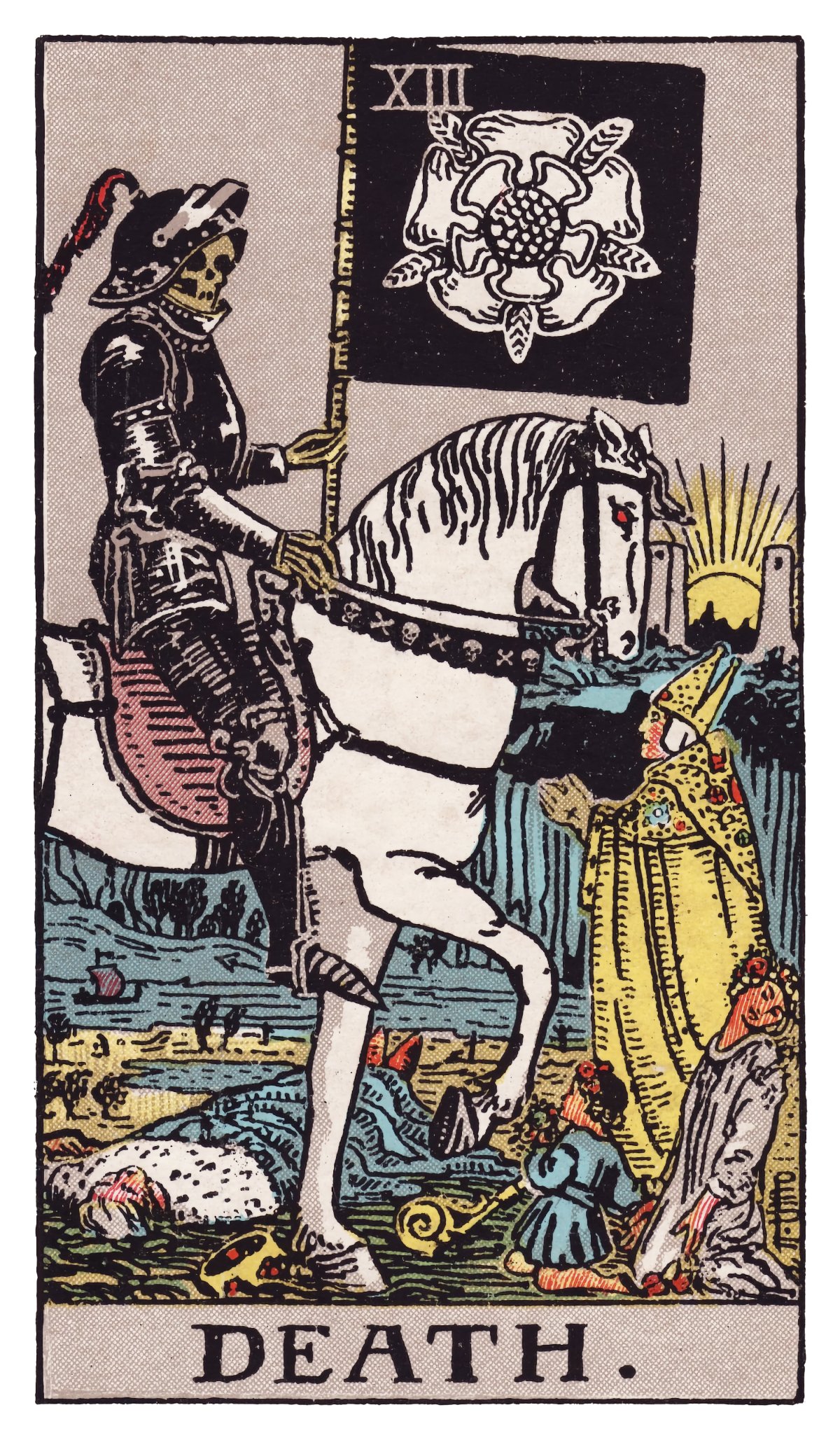
The Death card almost never predicts an actual death. In the vast majority of readings it points to a major ending — a relationship, a job, an identity, a phase of life — that has to close before something new can begin.
It's the most feared card in the deck by reputation and one of the least literal in practice. Even traditional tarot teaching treats it primarily as a transformation card, not a death omen.
What does the Death card actually mean?
At its core, Death represents an ending that's already underway, whether or not you've admitted it yet. The card shows a skeletal rider on a white horse, moving steadily through a landscape where a king has fallen and a child reaches up, a reminder that this kind of ending comes for everyone eventually, regardless of status.
The steadiness of the horse is part of the message. Death doesn't rush or negotiate. Whatever it's closing was going to close with or without your permission.
Why don't tarot readers take it literally?
Because the deck already has other ways to signal literal danger or loss, and Death almost never shows up in that role in practice. Readers treat the 22 Major Arcana cards as a map of psychological and spiritual stages, and Death sits at a specific stage in that map: the letting go that has to happen before rebirth. The card right after it, Temperance, is literally about integration and healing.
I'll say plainly that I don't think a tarot card can predict a literal death, and any reader who tells you it does is overstating what the practice can do.
What kind of "ending" does Death usually point to?
Relationships that have quietly already ended. Jobs or identities you've outgrown. Habits or self-images you're still performing out of habit rather than truth. Death shows up when a situation has stopped serving its purpose and continuing to prop it up is costing you more than letting it go would.
Near cards like the Tower, the ending is sudden and forced. Near cards like The Star or Temperance, the ending is difficult but leads somewhere gentler.
What does the imagery on the card actually represent?
Beyond the skeletal rider, most versions of the card include a rising sun in the background between two towers — a small detail that's easy to miss and central to the point. Death is framed on both sides by images of continuation: dawn on one end, the ordinary structures of a town on the other. The ending it depicts isn't the end of the story, just one chapter of it.
The white horse also carries meaning in most traditions: purity, or an ending that, however unwelcome, arrives clean rather than cruel.
What does Death mean reversed?
Reversed, it usually means resistance: clinging to something that's already over, or dragging out an ending that would be less painful if it just happened. It can also describe a slow, partial transformation instead of a clean break, change happening in fits and starts rather than all at once.
How should you respond when Death shows up in a reading?
Stop asking whether the ending is coming and start asking what you're holding onto that's already gone. That's usually the more useful question. Practically, this can mean finally naming a relationship as over, leaving a job you've mentally left already, or dropping a version of yourself you don't recognize anymore.
The card isn't asking you to force an ending that isn't ready. It's naming one that already is.
A way to check the reading against your life
Look for the thing you've been describing as "probably fine" for longer than feels honest. A relationship you defend more than enjoy. A job you talk about leaving every week. Death tends to surface exactly there, not in some abstract future, but in the ending you're already standing next to.
If you want to trace how this kind of transition connects to the rest of your year, a tarot and life path reading can put the card in a longer arc instead of one isolated pull.
Frequently asked questions
Does the Death tarot card mean someone will die?
Almost never, in standard tarot practice. It represents an ending or transformation, and readers are trained to treat literal-death interpretations as a rare exception rather than the rule.
What card comes after Death in the Major Arcana?
Temperance, which represents balance and integration, the healing that follows the ending Death describes.
Is Death a good card or a bad card to pull?
Neither, strictly. It's an ending, which is uncomfortable, but it usually clears space for growth that couldn't happen otherwise. Many readers consider it one of the more hopeful cards once its message is understood.
What does Death mean in a love reading?
Often the end of a relationship pattern, not necessarily the relationship itself: arguing styles, dependency, or dishonesty that has to die for the relationship to keep going in a healthier form.
How is Death different from the Tower card?
The Tower is sudden, external, and often shocking. Death is usually slower and more internal, an ending that's been building for a while even if you haven't consciously acknowledged it.
Why is Death numbered 13 in the Major Arcana?
Thirteen has long been associated with transformation and upheaval across several traditions, and its placement here reinforces the card's role as a turning point roughly in the middle of the Major Arcana's larger story of growth.
Tarot readings are a tool for reflection, not a substitute for professional medical, legal, or psychological advice.